Wednesday, 26 June 2013

Final images

These are my final images for my project. Some of them I have reviewed before, so those I will just use those reviews and a reason as to why I chose them.


I like the above image purely because of the repetition it provides. Taken on a Mamiya RB67 with a 50mm lens (equivalent to 28mm with a 35mm camera) which is a wide angle, and this provides many lines in the roof tiles. A very low f/ stop accounts for the low depth of field. I wish I could say this was completely natural, but I did have to play around with photoshop slightly; I upped the saturation slightly (only a couple of percent) and sharpened the image using a high pass filter.


I did write about this image after my first attempt at Automatic Photography, but I changed it to a monochrome photo after playing around on photoshop. I feel the change has made the image much more atmospheric, particularly the object creating a shadow in the laundry hamper. I also like the way the hamper almost glows due to diffusing light.


This is another image that I spoke about earlier, but have changed to black and white. I think the black and white makes the image a lot more contrasty, which gives even more of a feel of texture to the image.


I really like this image. All the lines point to the right hand side of the image, and when viewed from far away, or a smaller image, an arrow is clearly visible. Chiaroscuro is a key compositional element in this image. I did try this image in black and white, but it lost something in the transition, something which I can't quite put my finger on. There are not just the lines which create the 'arrow', but there are strong vertical lines in the bridge stanchions.


This is an image from Portugal; I like, and have chosen it, purely for the aesthetics behind the image. As I said about an image from my second attempt, images like this give across a sense of peacefulness. It could almost be used as an advertisement for the area it was taken in, to promote tourism. The image was taken on my Nikon D7000 at ISO100, f/8 and 1/250th of a second. It was taken at a wide angle, which is why the trees all seem to point inwards.


This is another from Portugal, but taken on my RB67; if I remember correctly, the settings were between f/8 and f/11 (but the distance accounts for the small depth of field) and around 250th of a second. I had to bring the exposure up in photoshop as it was very dark due to underexposure; I feel the fault in the lens I described in an earlier post may have had something to do with this though. The flower is almost the only item in the photo due to the exposure and the depth of field, so there isn't much else to focus on, apart from a few spots of yellow at the bottom of the image.

Monday, 24 June 2013

Portugal reviews

 Below are a few images I have selected from my trip to Portugal.


This one is nothing particularly special with regards to the formal elements, composition, or anything. I just like the fact that my subconscious decided to take this image, and there is a little model in the image; a feral cat finding shade on a hot day.


I like this image for the juxtaposition of the wrinkles on my uncle's elbow, the wrinkles in his t-shirt and the cracks in the building, which could be construed as a comment on age, and how everybody and everything ages whether they like it or not. The first thing the viewer's eye goes to, though it is not exactly in the golden section, is the wrinkly elbow; the lines this draws off seem to link to the creases in the t-shirt and cracks in the building, as if they are all interconnected.


The image above, and the following two were taken on Fuji Velvia ISO100 on medium format cameras. As they were fully manual cameras, I took the same images on my DSLR, and the ones I liked and could recreate easily were selected to be taken in this fashion. I didn't just take pictures subconsciously as with my DSLR as my settings would most likely have been incorrect (as there is no automatic setting) and they would have been out of focus (again, no auto-focus).

I like the above image purely because of the repetition it provides. Taken on a Mamiya RB67 with a 50mm lens (equivalent to 28mm with a 35mm camera) which is a wide angle, and this provides many lines in the roof tiles. A very low f/ stop accounts for the low depth of field. I wish I could say this was completely natural, but I did have to play around with photoshop slightly; I upped the saturation slightly (only a couple of percent) and sharpened the image using a high pass filter.


This image was taken with the same technique and camera and lens as the previous image, I just liked how sharp the plants are, and believe it is one of the better images that came out of my trip to Portugal. There are many orthogonal lines leading to a vanishing point in the top left hand corner of the image, and there is repetition in the railing supports. The plants are the obvious centre of attention, and a large burst of colour to a mostly bland image.


This final image, while taken on the same film as the previous two images, was taken on a different camera (hence the different ratio, this is in 6x9, whereas the previous two were in 6x7) which had a minimum focusing distance of 3 and a half feet; I believe the blurring is because I was stood slightly too close. There is a Hyundai hubcap in the golden section, so is naturally the first thing your eye sees, but it is also the only manmade (and therefore unnatural) object in the image, further reinforcement for your eye to be drawn to it. I like the vignette in the image, I just wish it was in focus! 

Second Attempt reviews

Below are a few images from my 2nd attempt at Automatic Photography.


I like this image; simple, yet divided by the telephone lines, as if a dividing line between the Earth and the sky. I also like the contrail joining the top telephone line, as if it is a statement about planes allowing us to access the skies from which we are so divided.


I like the sense of freedom this image gives the viewer. The depth of field makes the plants seem bigger and more spread out than they are in real life. Camera settings for this image were 82mm (35mm equivalent), ISO400, shutter speed; 1/1600 of a second and f/5.6.


I like the sense of peacefulness this image brings across; you can almost imagine yourself there in a hammock. The sun in the (aptly named in this case) golden section is the first thing your eye notices. If I was looking at this photo from a reviewers standpoint, I would say that it fell under the Terry Barrett category of Aesthetically Evaluative; I cannot state that as the photographer, as I feel an Aesthetically Evaluative photo can't be taken subconciously.


I like the simplicity of this image, yet the huge sense of freedom it gives. The bird lies almost directly in the golden section of the photo, but as there is nothing else in the photo, there is nothing else for the eye to go to anyways.


I like the lines in this image; even the beginning of the shadow in the middle of the image is in line with the bridge struts.


I really like this image. All the lines point to the right hand side of the image, and when viewed from far away, or a smaller image, an arrow is clearly visible. Chiaroscuro is a key compositional element in this image. 

Automatic Photography: Second Attempt & Portugal

Below are two contact sheets from my second attempt at Automatic Photography and my attempt at my final images in Portela dos Bezzerins, Portugal, respectively.


I am happy with the way most of these came out; less were blurry from this amount than the first attempt, but this is because I changed my camera settings so instead of a single focus point, it was on a continuous focus point; this allowed me to move as I was in the first attempt, but with less blurry images as a result.


I am also happy with the above images. The last four (roof tiles, plant pot overlooking road, flower and hubcap) were all shot on Fuji Velvia ISO100 on (bar the final image) my Mamiya RB67. I hoped to gain more images, but a fault with my lens, causing it to jam closed, prevented any more images from being taken. The final image was taken on an old Ensign Selfix 320, which has a minimum focusing distance of 3 and a half feet (just over a metre); I believe that I was slightly closer than this, hence the blurring.

To make this project safe (as I was blindfolded) I had a guide on both occasions. The 2nd attempt, I took the images on a closed road, so there were only cyclists and other pedestrians to contend with (during which time I only met one other person as it isn't a busy place). In Portugal, I also had a guide, but on an open road. The guide was there to warn me of any upcoming hazards, such as potholes or bumps in the road, which, if unseen by me, could potentially cause injury to myself.

Out of the images in this and my previous post, I will select six images to be my final pieces, and mount two for the presentation at The Citadel on the 11th of July.

Thursday, 13 June 2013

Automatic Photography: First Attempt

Below are some of the images from my first attempt at automatic photography. I took these while blindfolded with my camera on Priority setting (as described in my previous post). While most of the photos I took were blurry or boring (or both), I do like the ones below.


Out of the 200-odd shots I took around my house, this is my favourite. I love the way it is lit. My eye is drawn to the wall first, but then I notice the shadow in the laundry basket, begging the question, 'What's the creating the shadow?'


I like the texture of this image, the shallow depth of field serves only to heighten the impact of it. I think if I tried the image in black and white, it might be even more effective.


I like this one simply because (to me at least) it is aesthetically pleasing. Blue is clearly the most dominant colour in the image, followed closely by the brown-orange of the brickwork. I like the way I have somehow managed to capture two solar flares in the image; one in the window and one on the left of the image.


I like the depth in this image, the building really stands out from the skyline, giving an imposing feel to the image, almost like the house will topple onto the viewer.


I like the amount of dark space in this image, allowing the eyes to focus more on the outside. Like many of the other photos I took, dominant colours are greens and blues, not taking into account the rather more dominant black.


Above is a contact sheet of several images. Some of them work well (and I have used them above) and some of them do not work that well, the ones I feel do not work well are because they are blurred (e.g. bottom right).

Thursday, 23 May 2013

Automatic art

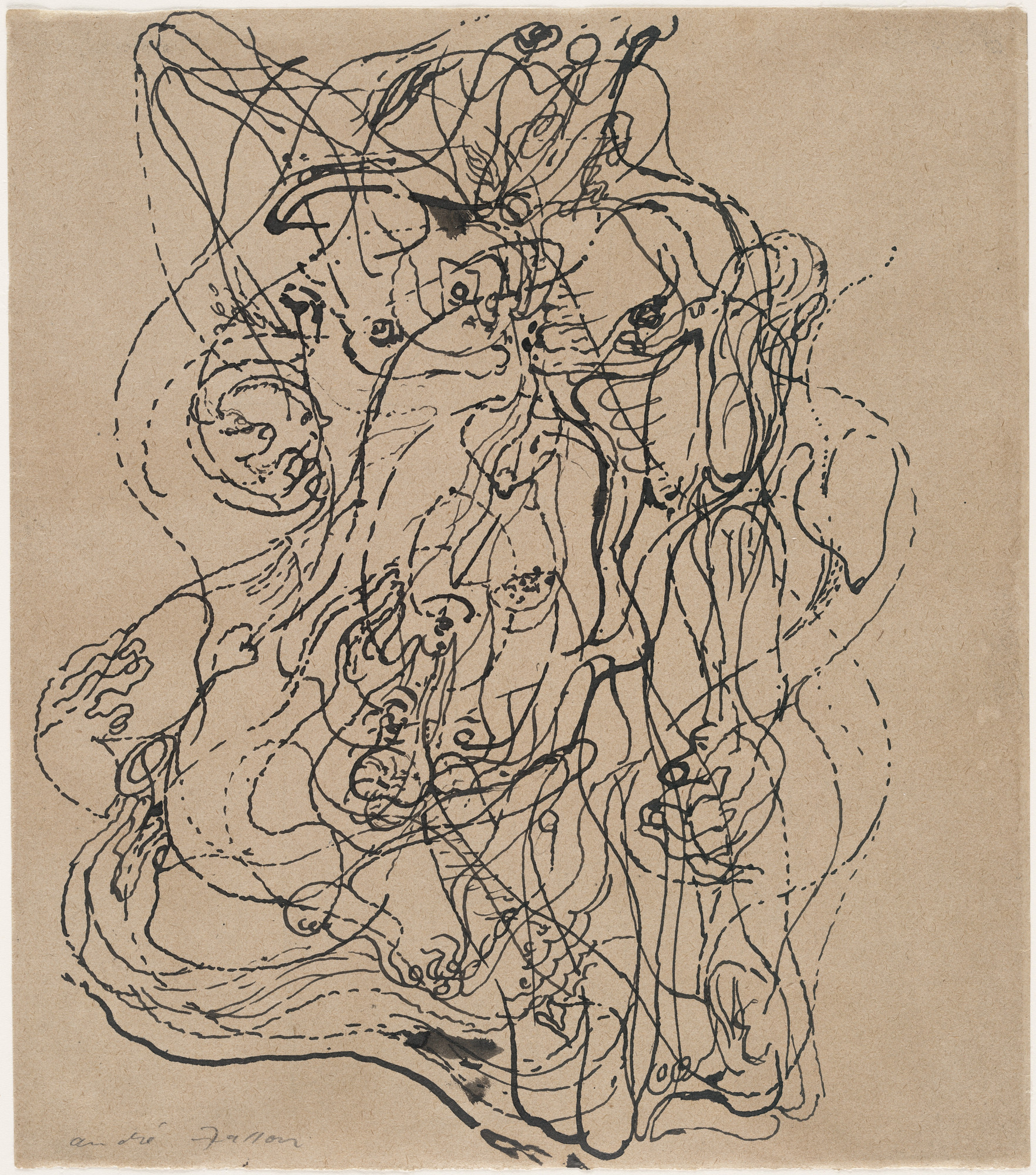
When researching the Surrealist painters, I came across Automatic Drawing. Pioneered by André Masson, Automatic Drawing is allowing the hand to move 'randomly' across paper; this is usually done just before sleep, when very drowsy, or just after awakening. Some artists would starve themselves of sleep for days, or take drugs so as to draw using this technique.


Above is André Masson's 'Automatic Drawing' (1924). This is one of the most cited images when the subject of Automatic Drawing comes up, and while at first glance it just looks like scribbles, certain shapes can be made out. Several hands, a mangled foot, and a boat on a turbulent sea are just a few of the things I can see within this image. This is a perfect example of how from chaos comes order.

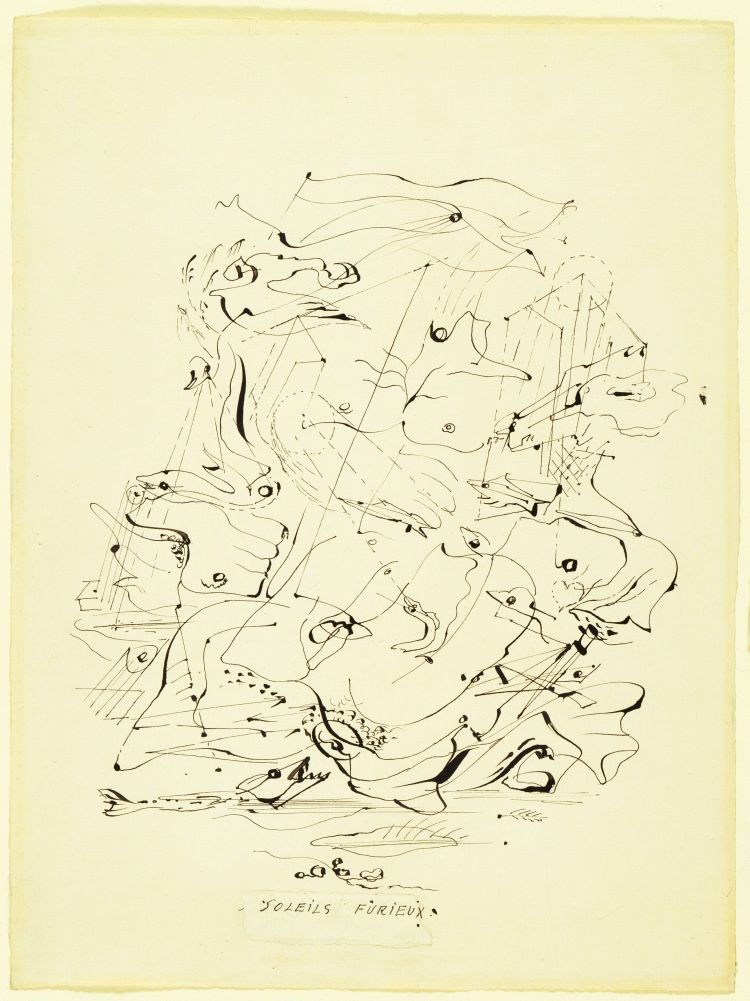
Above is 'Furious Suns', again by Masson (1925). While I cannot find any reference to it being an automatic drawing, I think I can be fairly certain in saying it is such.

I have decided to use another form of automatic art, photography. I will accomplish this by blindfolding myself and, by setting my camera to Priority (P) setting, which allows me to change the ISO, while leaving the shutter and aperture on automatic settings; at least that way I have some degree of control over the images. Once blindfolded, I will walk around a setting of my choice and allow my hand to point where it 'feels' like it wants to go, and press the shutter on my camera. So as to be safe, I will try this in my house at first, and then if I go somewhere less well known to me, I will take someone to act as a guide, to warn me of possible upcoming dangers.
I decided to change from my original proposal as I wasn't really feeling confident with it (mainly due to a lack of time), and after researching Surrealism, found the automatic side of things a more creative and interesting way to finish off the past two years at St Helens College.

Monday, 20 May 2013

Research

As I have chosen to explore the Surrealist side of photography, I will start by looking at the Surrealist painters.

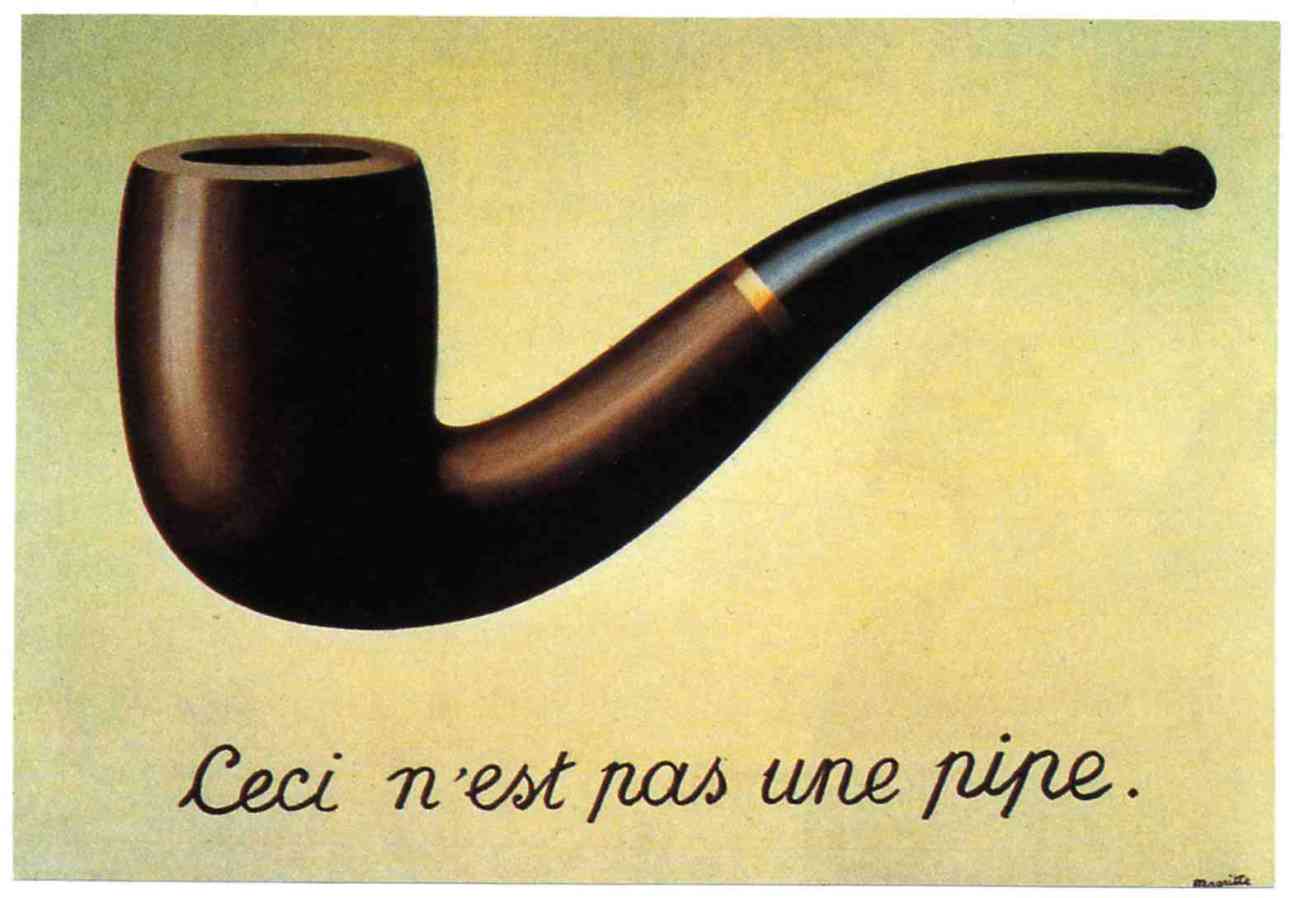
Above is René Magritte's famous 1929 painting: 'The Treachery of Images'. While the image itself is not particularly surreal, it does ask the question of how people view images. 'Ceci n'est pas une pipe' translates from French to 'This is not a pipe'; it is a picture of a pipe. Magritte's work challenges the observer's perceptions of reality. He said (on the painting):
'The famous pipe. How people reproached me for it! And yet, could you stuff my pipe? No, it's just a representation, is it not? So if I had written on my picture "This is a pipe," I'd have been lying!'


Above is the 1937 Magritte painting: 'The Spirit of Geometry'. It shows a mother and child with their heads swapped over, which makes you look twice at the image, as it defies preconceptions of reality. It is possibly a comment on a child's responsibility to care for their parents in later life, a role reversal from the parents caring for the children. It is also possibly (and more likely) a comment on the 'Madonna and Child' paintings that are rife throughout the art world.


Above is 'The Temptation of St. Anthony', painted by Salvador Dali in 1946. The painting shows a naked man (St. Anthony) defending himself with a cross against a giant horse and several giant elephants. The cross which St. Anthony is holding appears to be broken in his hand, this could be signifying a possible crisis of faith. Dali was a devout Catholic, yet was shocked by the bombing of Hiroshima in 1945; this could have caused him to lose faith in humans (for committing such an atrocity) and God (for allowing humans to commit it). The elephant furthest on the left of the painting has a large vertical tower on it's back, with a small hole at the top; this most likely indicates a penis, a theme common in Surrealism due to their fascination with sex (see Dona i Ocell by Joan Miro, a prime example). The two naked women are to symbolise the women with which the devil tried to tempt St. Anthony (St. Anthony became a hermit in the desert, and the devil tried to fight him with boredom, laziness and ghostly visions of women), yet are also another pointer to the surrealists' fascination with sex. The horse's hooves are on backwards and have some sort of moss, as if the horse has been in this position for a long time. It also appears to be recoiling in fear.
This part of the painting was influenced by another part of the story of St. Anthony, wherein he lived in an abandoned Roman fort. He was attacked by the devil again, who conjured phantom animals to attack St. Anthony, but Anthony just laughed and said "If any of you have any authority over me, only one would have been sufficient to fight me." Upon saying this, the animals disappeared. This was put down to a victory granted by God. This could explain the horse's recoil, it is scared of St. Anthony's faith.


Above is a famous image by Jerry Uelsmann ('Untitled', 1969). Using traditional darkroom methods, Uelsmann creates very surreal pictures using up to seven enlargers at any one time for just one final image on silver-gelatine paper. Uelsmann's image fall under the category of 'Interpretive' (when using Terry Barrett's photographic categories system). Many things can be read from this image, the exposed roots of the trees could be a comment on man's impact on the environment, made even more poignant with a stunning background, and the dried pea pod could be a very crude metaphor calling attention to a lack of peace in the world. I am a big fan of this image, as to me it is very aesthetically pleasing, particularly in monochrome; I don't think it would have been anywhere near as impacting if it was in colour.


Above is an image by Tom Chambers, entitled 'Autumn Moorage', from his collection 'Illumination'; it shows a man in a boat, in a field of dead flowers (dandelions, I believe). He is looking over the side of the boat with a lamp in his hand, as if he has dropped something overboard. Rule of thirds draws your eye to the man in the boat, aided by the light from his lamp; your eye is also drawn to the anchor in the bottom right side of the image. I believe this is a comment on unsustainable fishing, the dead flowers indicating that the sea is or will be dead soon, yet the anchor is there as a symbol of hope. While it is heavily photoshopped, I think the lighting of this image, the clouds in particular make this photo quite visually stunning, and even eerie.

Wednesday, 8 May 2013