As I have chosen to explore the Surrealist side of photography, I will start by looking at the Surrealist painters.
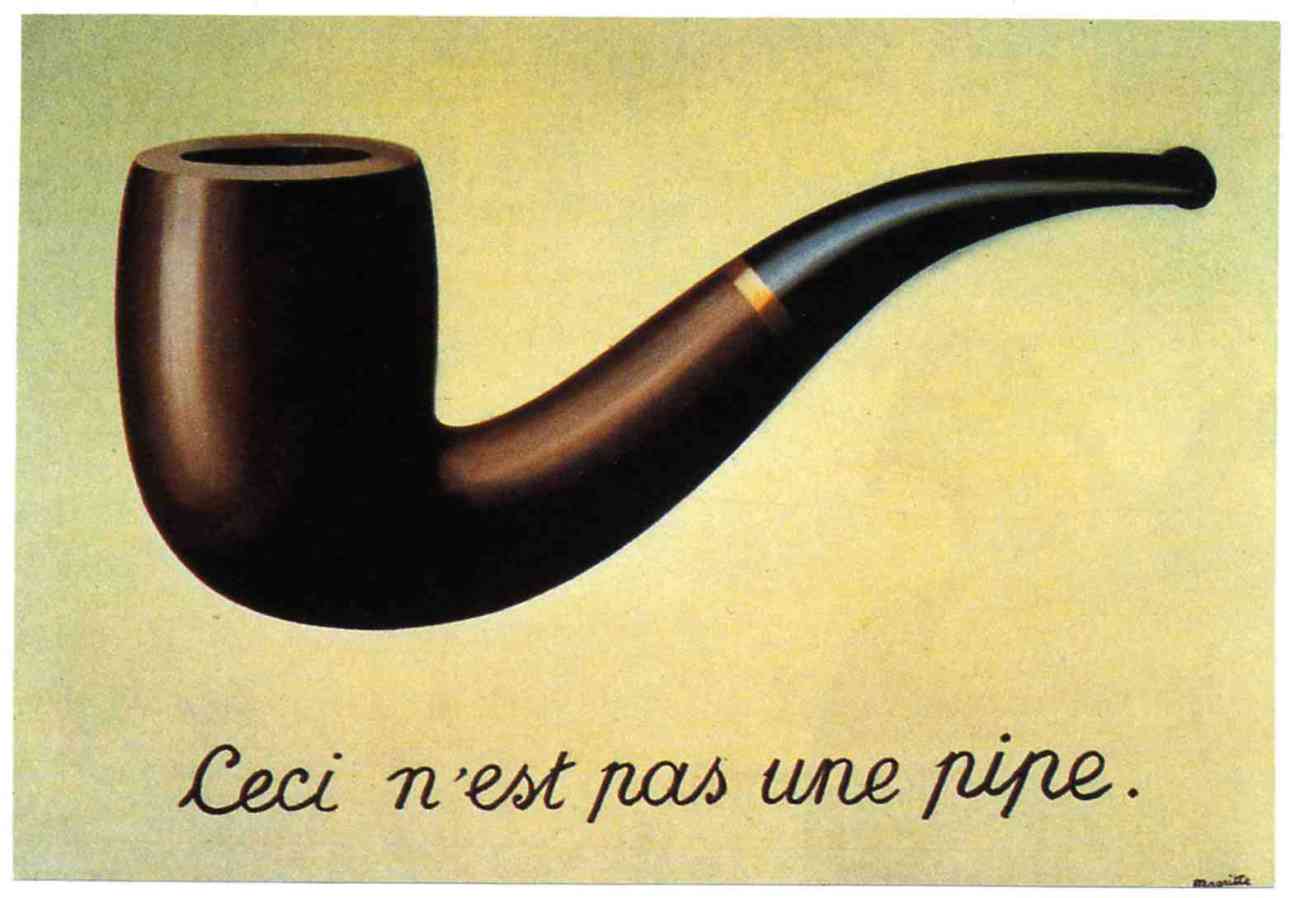
Above is René Magritte's famous 1929 painting: 'The Treachery of Images'. While the image itself is not particularly surreal, it does ask the question of how people view images. 'Ceci n'est pas une pipe' translates from French to 'This is not a pipe'; it is a picture of a pipe. Magritte's work challenges the observer's perceptions of reality. He said (on the painting):
'The famous pipe. How people reproached me for it! And yet, could you stuff my pipe? No, it's just a representation, is it not? So if I had written on my picture "This is a pipe," I'd have been lying!'
Above is the 1937 Magritte painting: 'The Spirit of Geometry'. It shows a mother and child with their heads swapped over, which makes you look twice at the image, as it defies preconceptions of reality. It is possibly a comment on a child's responsibility to care for their parents in later life, a role reversal from the parents caring for the children. It is also possibly (and more likely) a comment on the 'Madonna and Child' paintings that are rife throughout the art world.

Above is 'The Temptation of St. Anthony', painted by Salvador Dali in 1946. The painting shows a naked man (St. Anthony) defending himself with a cross against a giant horse and several giant elephants. The cross which St. Anthony is holding appears to be broken in his hand, this could be signifying a possible crisis of faith. Dali was a devout Catholic, yet was shocked by the bombing of Hiroshima in 1945; this could have caused him to lose faith in humans (for committing such an atrocity) and God (for allowing humans to commit it). The elephant furthest on the left of the painting has a large vertical tower on it's back, with a small hole at the top; this most likely indicates a penis, a theme common in Surrealism due to their fascination with sex (see
Dona i Ocell by Joan Miro, a prime example). The two naked women are to symbolise the women with which the devil tried to tempt St. Anthony (St. Anthony became a hermit in the desert, and the devil tried to fight him with boredom, laziness and ghostly visions of women), yet are also another pointer to the surrealists' fascination with sex. The horse's hooves are on backwards and have some sort of moss, as if the horse has been in this position for a long time. It also appears to be recoiling in fear.
This part of the painting was influenced by another part of the story of St. Anthony, wherein he lived in an abandoned Roman fort. He was attacked by the devil again, who conjured phantom animals to attack St. Anthony, but Anthony just laughed and said "If any of you have any authority over me, only one would have been sufficient to fight me." Upon saying this, the animals disappeared. This was put down to a victory granted by God. This could explain the horse's recoil, it is scared of St. Anthony's faith.

Above is a famous image by Jerry Uelsmann ('Untitled', 1969). Using traditional darkroom methods, Uelsmann creates very surreal pictures using up to seven enlargers at any one time for just one final image on silver-gelatine paper. Uelsmann's image fall under the category of 'Interpretive' (when using Terry Barrett's photographic categories system). Many things can be read from this image, the exposed roots of the trees could be a comment on man's impact on the environment, made even more poignant with a stunning background, and the dried pea pod could be a very crude metaphor calling attention to a lack of peace in the world. I am a big fan of this image, as to me it is very aesthetically pleasing, particularly in monochrome; I don't think it would have been anywhere near as impacting if it was in colour.

Above is an image by Tom Chambers, entitled 'Autumn Moorage', from his collection 'Illumination'; it shows a man in a boat, in a field of dead flowers (dandelions, I believe). He is looking over the side of the boat with a lamp in his hand, as if he has dropped something overboard. Rule of thirds draws your eye to the man in the boat, aided by the light from his lamp; your eye is also drawn to the anchor in the bottom right side of the image. I believe this is a comment on unsustainable fishing, the dead flowers indicating that the sea is or will be dead soon, yet the anchor is there as a symbol of hope. While it is heavily photoshopped, I think the lighting of this image, the clouds in particular make this photo quite visually stunning, and even eerie.